
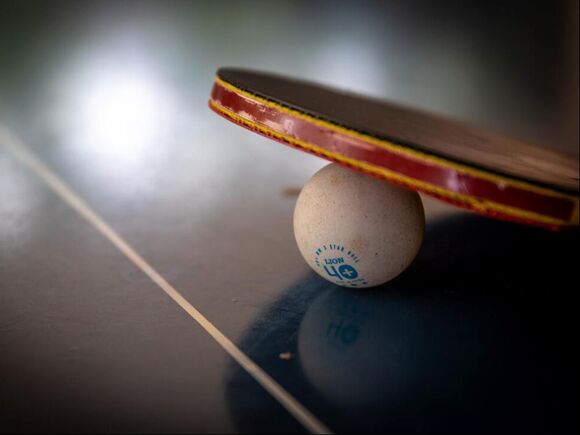
 When I was 15, my parents bought a house and my father bought a ping pong table. I didn’t know how to play, and my sister wasn’t interested, so the table went unused except for an occasional game with my father. I left to go to a music camp a few weeks later. Although I played the piano unenthusiastically and wasn’t interested in immersing myself in music, it meant I’d be away from my family for a month and that was worth a lot.
On the first full day of camp we had to audition for lessons, orchestra, and ensembles. I wasn’t skilled enough to play badly intentionally so in addition to my private lesson, I was signed up for four-hand piano ensemble. I argued that I wasn’t good enough to play with another person on the same piano, but the instructor, mistaking honesty for humility, assured me I would learn. Desperate for something to do besides play the piano, I wandered into a building I hadn’t seen before, into a large room where a man was sitting next to a ping pong table, looking as lonely as I felt. He brightened up when he saw me. “Want to play?”
2 Comments
 In 1978, as part of my work in the University of Delaware’s theatre department, I created a play for children based on Hans Christian Andersen’s story, The Snow Queen. The main human characters are Gerda, Gerda’s Grandfather, Kai, and the Snow Queen.
The story is well-known and a lot of students turned out for the auditions. I asked each person what mattered most to them in the story and why they wanted to play a particular part. Some shrugged, not prepared to answer with any depth. A few loved the story and wanted to be in the production. I chose the most talented students who had clearly thought about their participation.  In April 1959 I answered a newspaper ad written by an internationally renowned folk-dance teacher. He was looking for people to join him in teaching folk dancing in a variety of European countries for 11 weeks during the summer. I’d been longing to go to Europe. This seemed a great way to go since I’d been folk dancing for years. What made it possible to apply was that his timetable coincided with my public-school teaching schedule. I responded immediately.
 In the early 1960’s, education in Providence, RI was segregated. Black children went to an all-Black school that was separate and unequal from the schools for white children. When the school building for Black children was condemned, the city of Providence was forced to close it and integrate Black children into previously all-white schools.
An article in the local newspaper described how the city of Providence had created a project titled ‘Cinderella,’ and was asking for volunteers to help “improve Black children’s academic skills.” Despite my feelings about the need for such a project—years-long educational neglect—I volunteered to work with a small group of 4th grade girls, planning to use the story of Cinderella as part of my strategy to develop their language arts abilities. I volunteered because I cared about the kids. Privately I wondered if the project would have been developed had the school for Black children not been judged too great a risk for continued use.  In 1990 I taught a seminar at an International Conference on Innovative Teaching that was held at Janus Panonius University in Pecs, Hungary. In 1991, while leading a seminar in an international program for teachers of language arts at the University of Delaware, I met one of the Hungarian university faculty members, a participant in the course. She was intrigued by what she called “my unusual teaching strategies,” using imagemaking and storymaking to teach language and persuaded her Chair to invite me to teach a similar course for graduate students studying English as a foreign language. I accepted the invitation and prepared to teach in Pecs at the university.
|
Monthly StoriesStories inspired by world tales to challenge and comfort. Archives
July 2025
Categories |
 RSS Feed
Copyright © Nancy King 2020 | Site Design by Angulo Marketing & Design
|
|
Nancy King is a widely published author and a professor emerita at the University of Delaware, where she has taught theater, drama, playwriting, creative writing, and multidisciplinary studies with an emphasis on world literature. She has published seven previous works of nonfiction and five novels. Her new memoir, Breaking the Silence, explores the power of stories in healing from trauma and abuse. Her career has emphasized the use of her own experience in being silenced to encourage students to find their voices and to express their thoughts, feelings, and experiences with authenticity, as a way to add meaning to their lives.
|